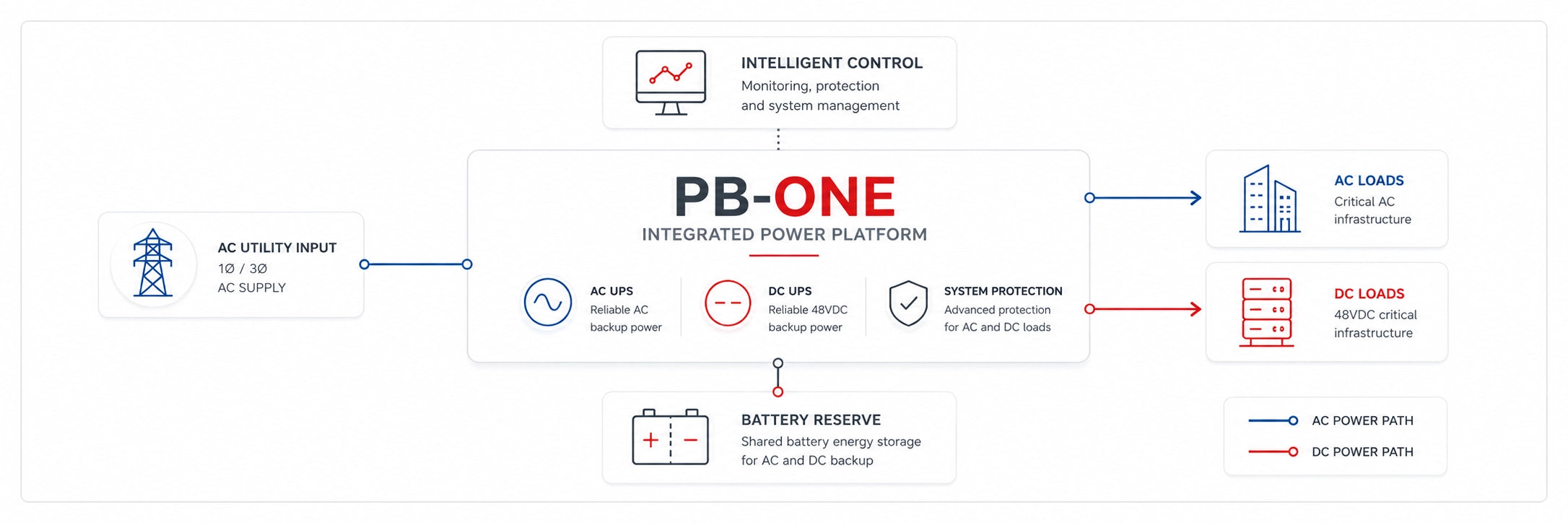
When “critical” means the power can’t stop for hours, not minutes.
Security and building-management systems are increasingly expected to stay online for hours, not minutes. Powerbox ONE Series separates power capacity from battery runtime, allowing each to scale independently without oversizing the power electronics simply to extend backup time.
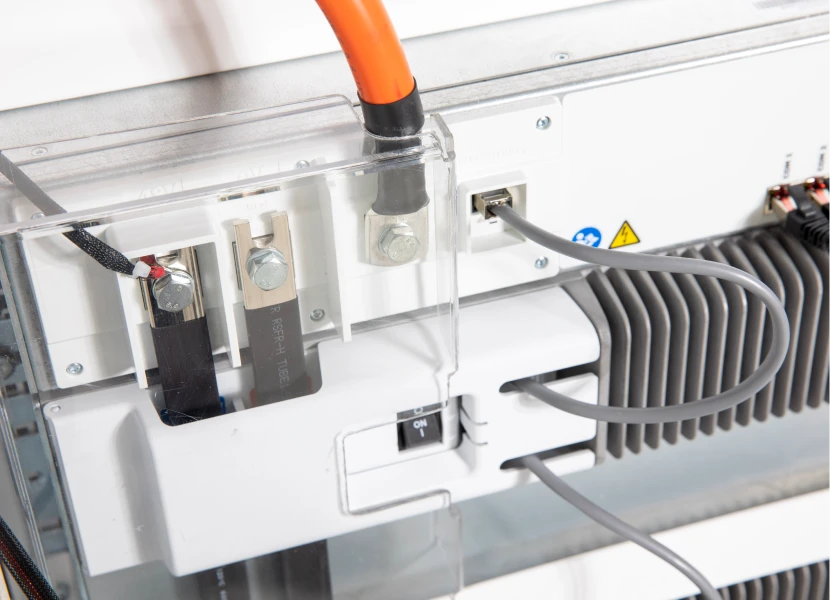
Long runtime changes the way a UPS should be designed.
A conventional UPS is typically selected around its AC load, with additional battery cabinets added when more runtime is required. That approach works well for short-duration backup. At multi-hour runtimes, the relationship between load, battery capacity and charging power becomes much more important.
The battery bank may increase substantially, while charging capability remains tied to the UPS frame. The result can be an oversized UPS selected primarily to provide enough charging capacity, or a system with extended recharge times and less flexibility around future expansion.
For security, BMS and communications infrastructure, where relatively modest loads may need to operate for four, six or eight hours, that becomes an important design consideration.
At multi-hour runtimes, the battery and recharge requirement can become a bigger design driver than the AC load itself.
 CONVENTIONAL APPROACH: EXTEND RUNTIME WITH ADDITIONAL BATTERY CAPACITY
4–10 kVA may be all the site actually requires.
4–8 hours can require substantial stored energy and corresponding recharge capacity.
Built to scale power and energy independently.
ONE Series separates power capacity, charging capacity and stored energy.
Powerbox ONE Series is built around a shared 48V DC bus, with modular power conversion and energy storage sized around the application. Add power modules as load grows. Add battery modules as runtime requirements increase. Charging capacity can scale with the battery bank, without requiring the entire UPS to be replaced or unnecessarily oversized.
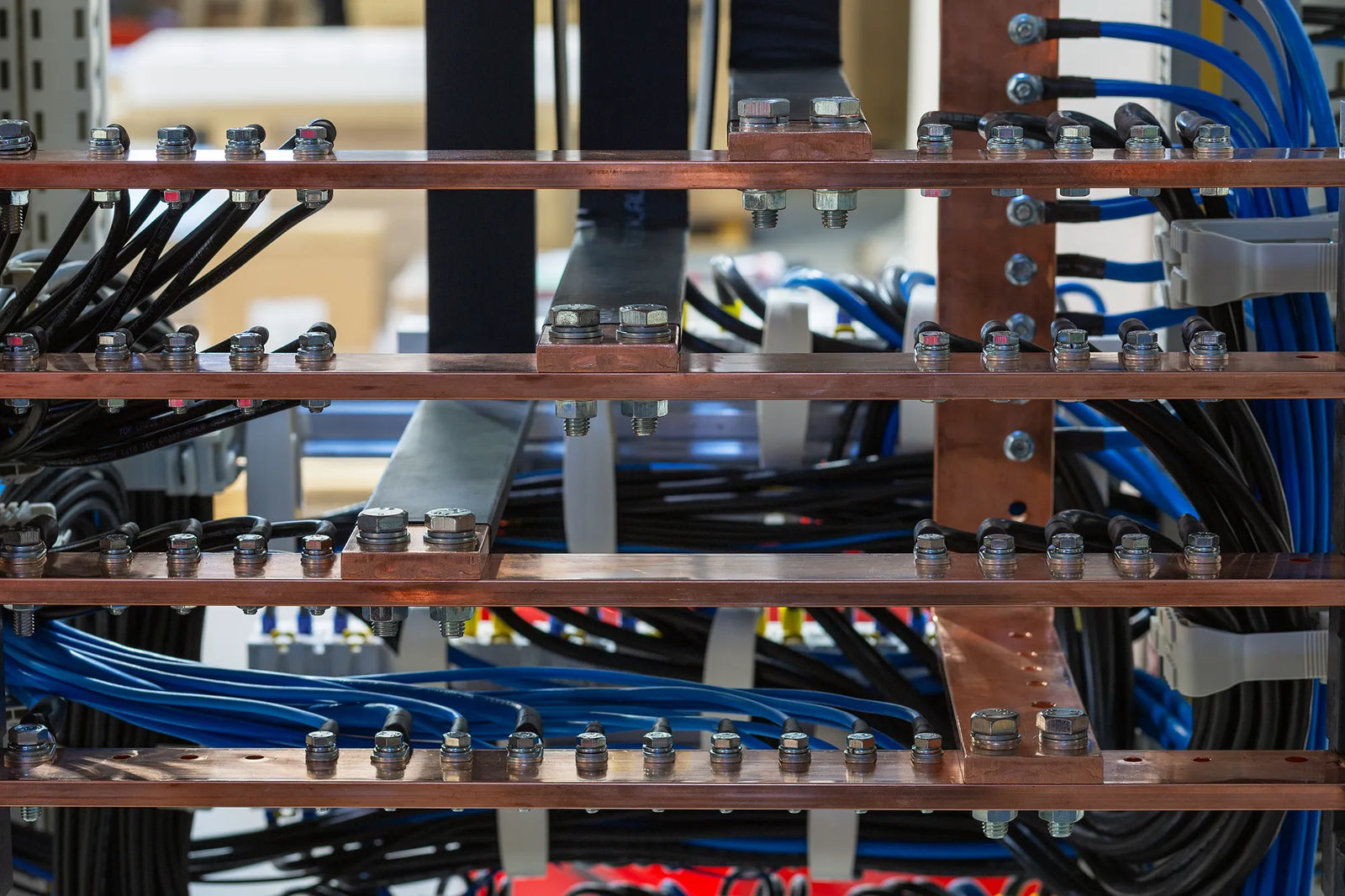
AC and 48VDC loads. One critical power platform.
The shared 48VDC architecture allows ONE Series to support conventional AC loads alongside equipment that can operate directly from 48VDC. Network switches, communications equipment and other compatible security loads can be supplied directly from the DC bus, sharing the same battery reserve without an unnecessary DC-to-AC-to-DC conversion path.
- AC and 48VDC loads supported from the same system
- Direct DC loads share the same monitored battery reserve
- DC distribution and protection configured around the connected equipment
Modular resilience
Power conversion is distributed across hot-swappable modules. N+1 or N+2 redundancy can be configured where the application requires continued operation following a module failure.
Charging scales with storage
Charging capacity can be increased as battery capacity grows, allowing recharge performance to be engineered around the installed battery bank rather than a fixed UPS frame.
More usable energy, less space
High-capacity lithium modules provide greater usable energy density than conventional standby lead-acid systems, reducing the battery footprint as runtime increases.
Expand without starting again
Size the system around today’s load and runtime requirement, then add power or battery capacity as the site evolves without replacing the complete system.
Power, energy and visibility in one platform.
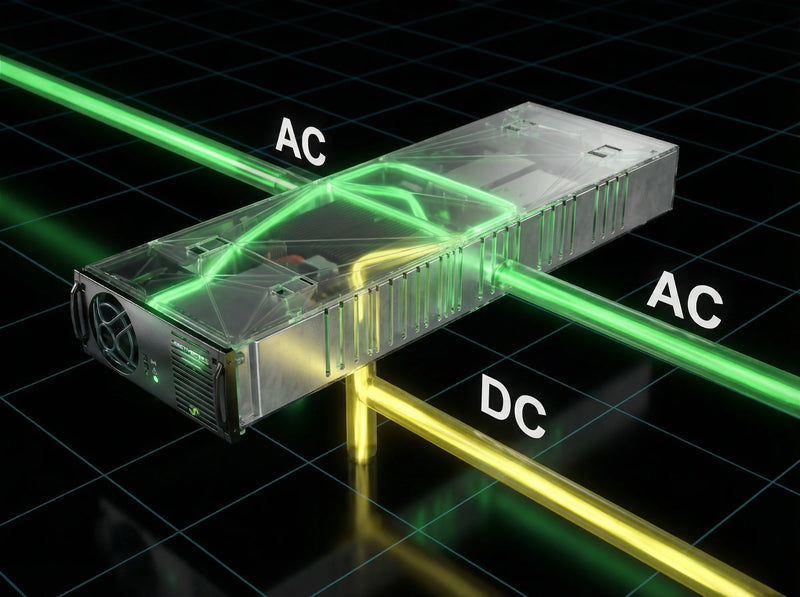
Modular power conversion, built to scale
Each ONE Series power module combines rectification and inversion within the shared 48V DC architecture. Power capacity can be added as the load grows, with redundancy configured around the availability requirement.
- 1.5kVA AC / 1.2kW DC per module
- Rectification and inversion in one module
- Hot-swappable module replacement
- N+1 or N+2 redundancy available
- Add modules as power or charging requirements grow
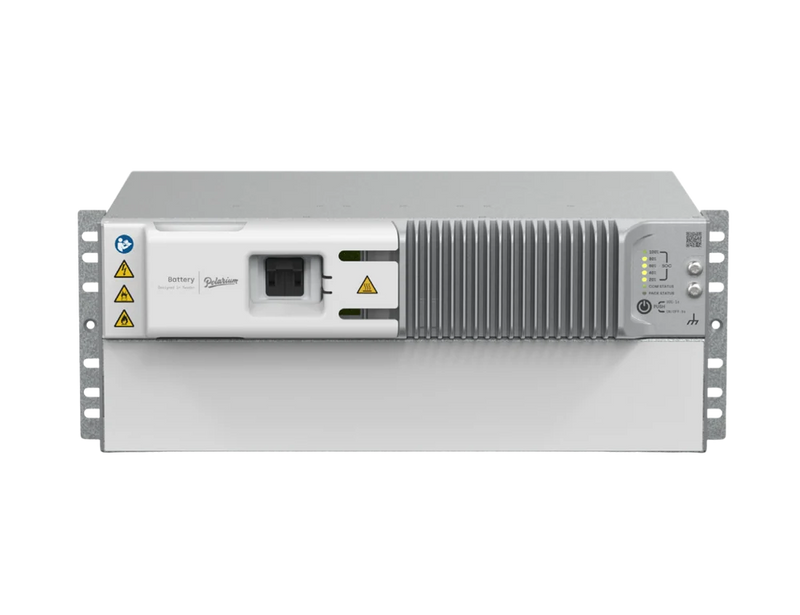
High-density lithium, connected
Each 4U lithium battery module provides 230Ah of rated capacity within the shared 48V architecture. ONE Series uses a conservative 80% depth-of-discharge basis for standard sizing, while the integrated BMS provides live battery information via Modbus.
- 230Ah / 11.04kWh rated capacity
- 184Ah / ~8.8kWh standard design capacity
- Compact 4U rack format
- SOC, SOH, voltage, current and alarms
- BMS communications via Modbus
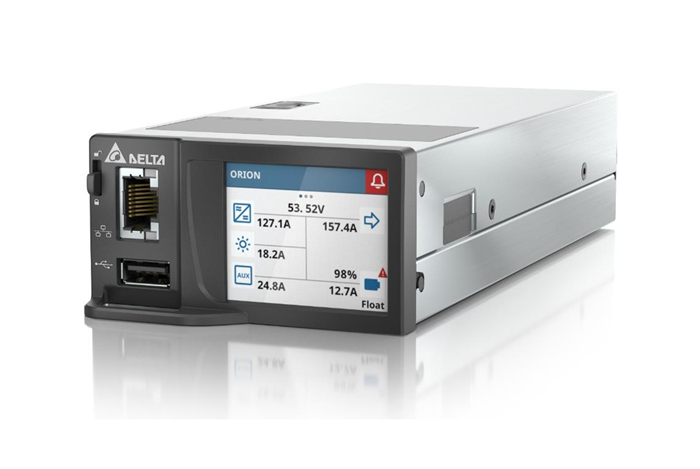
Local, remote and multi-site visibility
ONE Series provides visibility of the complete power system, from power-module and battery status through to connected loads and active alarms. System information can be viewed locally at the cabinet or accessed remotely through the network.
- Local monitoring via controller LCD display
- Remote browser-based monitoring over Ethernet
- SNMP and remote alarm integration available
- Battery status, loads and system alarms in one view
- Multi-site monitoring available for projects with multiple installations
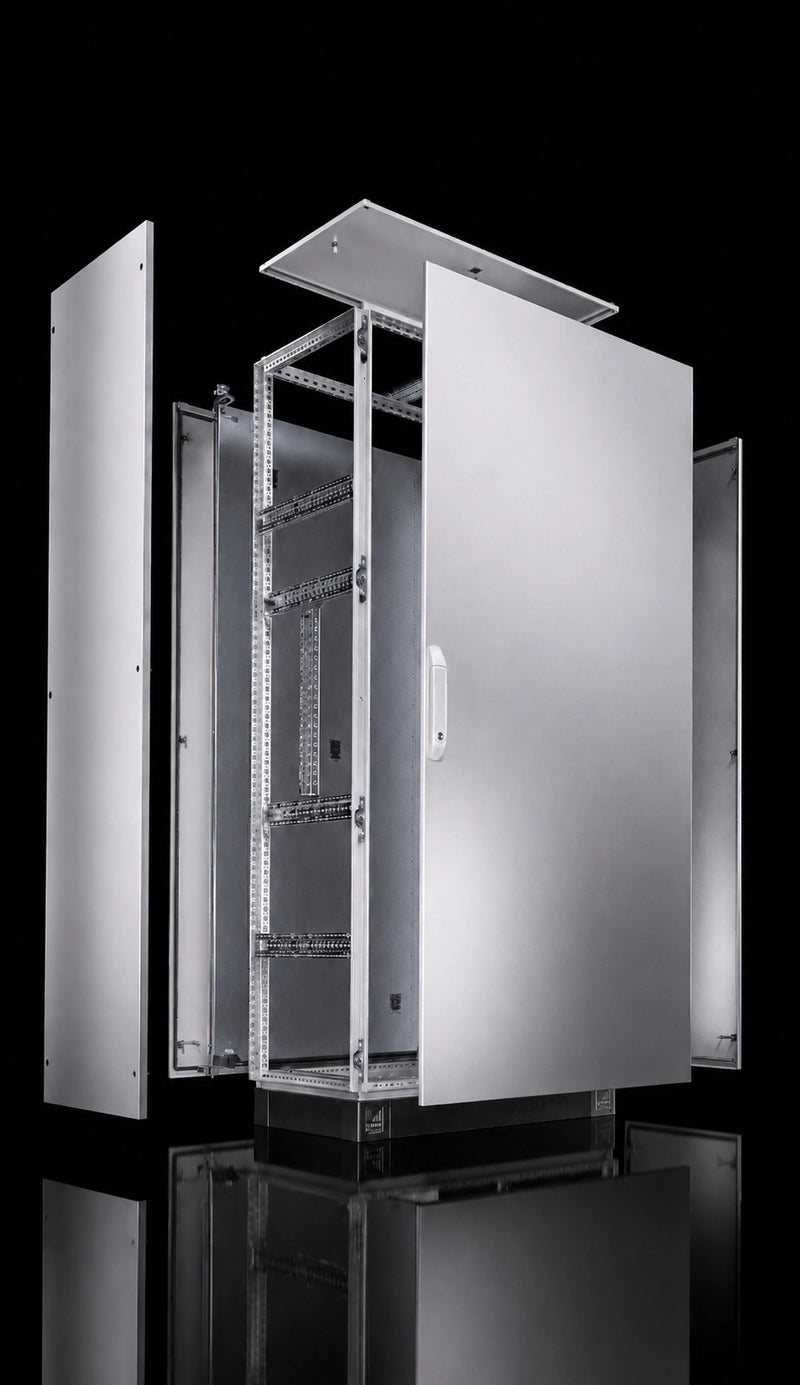
Configured for the environment
ONE Series uses the same underlying power platform across controlled and industrial indoor environments, with the enclosure, cable entry and thermal-management approach configured around the installation.
- IP20 controlled-environment platform
- IP52 industrial indoor platform
- 19-inch equipment architecture
- Top or bottom cable entry where required
- Ventilation, heating and cooling engineered around site conditions
Ready to put a number on your own site?
Size your load & runtime →Power systems are what we do.
ONE Series is a new standardised Powerbox platform, but the engineering behind it is not new to us. Powerbox has designed, supplied and integrated DC power, battery backup and modular power systems across telecommunications, rail and critical infrastructure for years.
Powerbox ONE Series brings that experience into security and building infrastructure, combining modular power conversion, lithium energy storage, distribution, monitoring and enclosure integration into one engineered platform.
New platform. Established power systems experience.
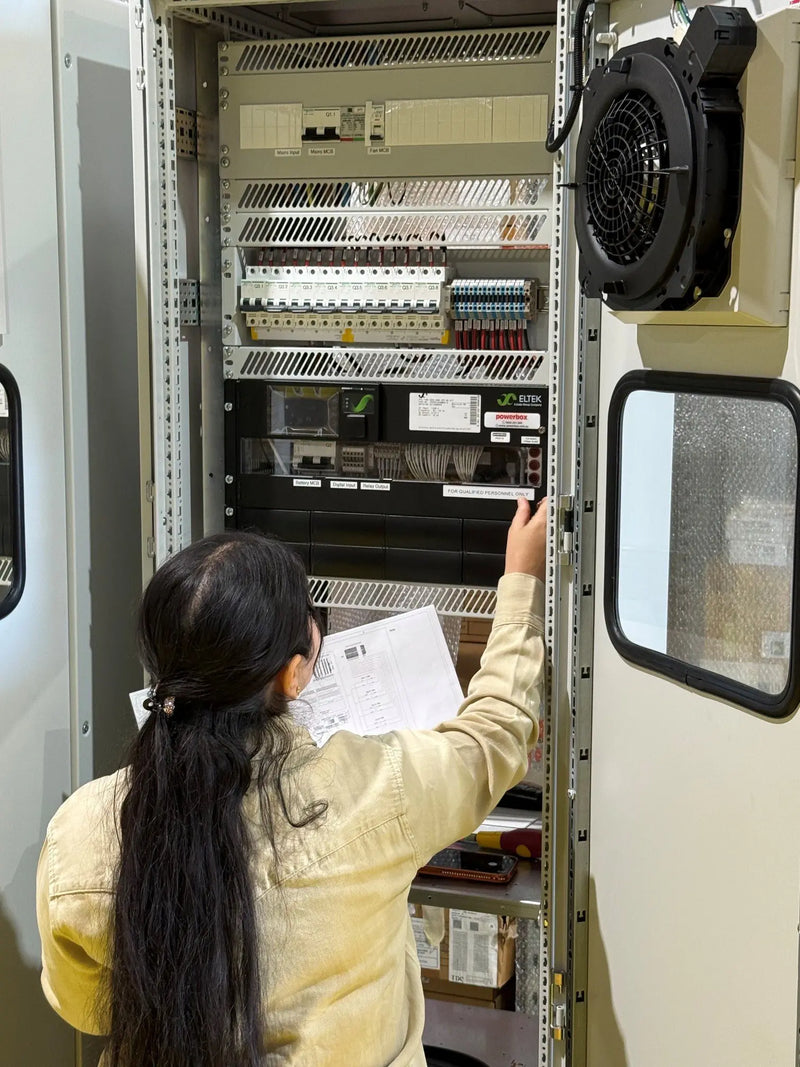
Power systems engineering, not just assembly
Powerbox is a power systems specialist first. ONE Series is engineered around the complete electrical requirement, including load, runtime, charging capacity, battery storage, distribution, redundancy and environmental conditions.
That means the system is configured as a complete power solution rather than a collection of individual components. Application Engineering considers how the load, battery bank, recharge requirement and installation environment interact before the final configuration is released.
- Load and runtime analysis
- Battery and recharge sizing
- Redundancy philosophy
- AC and DC distribution
- Environmental requirements
- System-level configuration
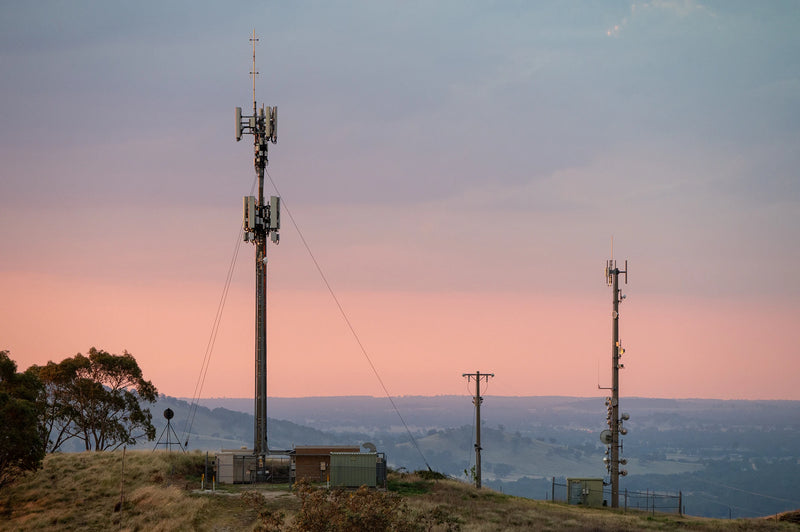
Experience across demanding infrastructure
Powerbox has supplied and integrated power systems for telecommunications, rail, utilities and critical infrastructure, where correct sizing, reliable backup and disciplined system design matter.
These applications regularly involve extended autonomy, DC power architectures, battery-backed systems, remote monitoring and equipment installed in environments where power-system design has to be treated as part of the infrastructure, not as an accessory.
- Telecommunications
- Rail & transportation
- Power & water utilities
- Remote infrastructure
- Battery-backed DC systems
- Critical communications
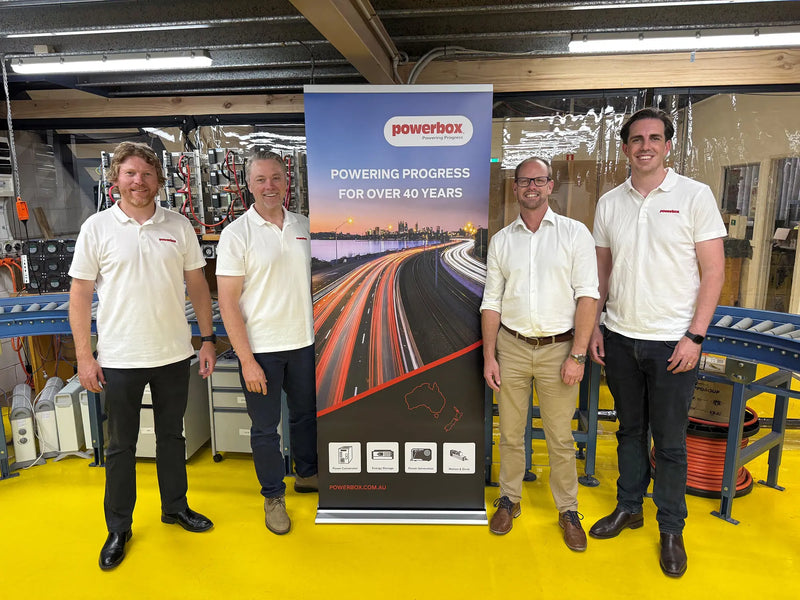
Engineered and supported locally
ONE Series is designed, configured and supported by Powerbox Australia. Our Application Engineering team handles sizing and system configuration, while our local integration and test capability carries that through manufacture, documentation and final system validation.
This gives customers a clear line from the initial engineering decision through to the finished system and ongoing technical support.
- Application Engineering
- Local configuration
- Enclosure integration
- System integration & testing
- Documentation
- Technical support
Want to walk through your project with us?
Engineered for the environment
it operates in.
 CONTROLLED ENVIRONMENT · IP20
Controlled environment
For security equipment rooms, communications rooms, control rooms and other clean indoor technical environments.
TYPICAL CONFIGURATION- 19-inch equipment architecture
- Ventilation matched to system heat load
- Integration with communications and technical equipment
- Top or bottom cable entry where required
- Cabinet layout configured around power, battery and distribution equipment
 INDUSTRIAL ENVIRONMENT · IP52
Industrial environment
For plant rooms, infrastructure sites and other uncontrolled indoor environments where dust, temperature and airborne contaminants require additional consideration.
TYPICAL CONFIGURATION- IP52 enclosure protection
- Filtered forced-air ventilation
- Replaceable filter elements
- Thermostatically controlled airflow
- Heating or additional cooling configured where site conditions require it
Thermal management is engineered around the installation.
Ventilation, heating and cooling provisions are selected to suit the actual operating conditions, including:
- Site ambient temperature
- Power-system heat load
- Battery operating requirements
- Dust and contaminant exposure
- Installation environment
These provisions are configured as required for each application rather than included as a fixed package across every enclosure.
Outdoor installations
The standard IP20 and IP52 ONE Series platforms are intended for indoor environments. Outdoor or direct-weather-exposed installations require a project-specific enclosure solution engineered around the site conditions.
 Efficient cooling keeps electronics, batteries and connected loads operating within their designed limits.
The lowest purchase price isn’t always the lowest-cost system.
Powerbox ONE Series may carry a higher initial system cost than a conventional UPS with battery extension cabinets. The comparison changes over the life of the installation.
Long-life lithium storage, modular power electronics, continuous battery visibility and the ability to expand power and energy independently can reduce replacement frequency, avoid unnecessary upfront oversizing and allow the system to evolve as site requirements change.
For infrastructure expected to remain in service for a decade or more, the relevant question is not simply what the UPS costs to buy, but what it costs to own, maintain and adapt over its operating life.
Long-life lithium energy storage and modular architecture designed for long-term infrastructure ownership.
Connected battery visibility and replaceable power modules that support informed maintenance and easier system support.
Power and battery capacity can be expanded as site requirements change, reducing the need to replace the entire system.
See what it looks like for your site.
Load, runtime, and redundancy requirements are different on every project. The configurator walks through your site conditions and generates a preliminary specification and part number to send straight to Sales.
- Set installation environment, AC supply, and load
- Choose backup runtime — standard or custom
- Get a power module and battery module count, sized to spec
- Generate a preliminary part number to forward for quoting
Talk through your load, runtime and site requirements with the Powerbox team.

Common questions about
Powerbox ONE Series
How is ONE Series different from a conventional UPS with battery extension cabinets?
On many conventional UPS systems, the charger is sized to the runtime the unit shipped with, so adding battery extension cabinets doesn’t necessarily add charging capacity. ONE Series scales power conversion, charging capability and battery storage together, so the system is engineered around your actual application rather than a fixed standard footprint.
Why use a shared 48V DC architecture?
Power modules, battery modules and compatible 48VDC loads all connect to a common DC bus. This keeps power conversion, energy storage and DC distribution on one shared architecture, rather than requiring separate conversion stages for each.
What backup runtimes can ONE Series support?
Standard runtimes of 2, 4, 6 and 8 hours are built into the configurator, with a custom runtime entry available for anything outside those steps. Final battery sizing is confirmed by Powerbox Application Engineering.
How is recharge time handled after an extended outage?
Recharge capability is an engineered parameter rather than a fixed figure. As battery storage increases, charging capacity can be scaled to match, so recharge time is sized to the application instead of being left as an afterthought.
Can the system be expanded after installation?
Power and battery capacity can be expanded, subject to cabinet capacity, available module positions and engineering limits. Expansion isn’t unlimited, so Application Engineering can confirm what headroom exists for a given installation.
What happens if a power module fails?
Power modules are hot-swappable and can be configured with N+1 or N+2 redundancy, so a failed module can be replaced without de-energising the system. Continued operation depends on sufficient spare capacity having been configured.
Can ONE Series support both AC and 48VDC loads?
Yes. Compatible 48VDC loads can be supplied directly from the shared, battery-backed DC bus alongside standard AC loads, without a separate conversion stage in between.
Why does ONE Series use lithium batteries?
Lithium battery modules offer higher energy density than lead-acid in a comparable footprint, with high usable capacity and battery management system intelligence connected directly into the ONE Series monitoring platform.
How is the lithium battery monitored?
Battery information such as state of charge, state of health, voltage and current is communicated from the Polarium battery BMS via Modbus into the ONE Series monitoring and control system.
What installation environments are supported?
Two standard platforms: IP20 for controlled indoor environments such as comms and security equipment rooms, and IP52 for industrial indoor environments such as plant rooms. Direct outdoor installation sits outside these two standard platforms and requires custom engineering.
Is ONE Series a standard product or a custom-engineered system?
ONE Series is a standardised Powerbox platform that’s configured around individual project requirements, including load, runtime, battery, distribution and installation environment, rather than a fixed off-the-shelf product or a fully bespoke build.
Is the configurator a final engineering selection, and what information is required?
The configurator provides a preliminary selection based on the installation environment, AC supply and load you enter. Powerbox Application Engineering reviews and confirms the final configuration before order.
Power, runtime and resilience.
Engineered as one system.
Tell us what needs to remain powered, for how long, and where it will be installed.
Powerbox Application Engineering validates the final configuration.